

I know exactly what a good connection in tango feels like, but if someone asked me to define it, I wouldn’t know how. It reminds me of that old paradox by Thomas Aquinas about time: I know what it is, but when asked to define it, I can’t answer.
Most tango dancers have one or two unforgettable tandas in their lives – I can recall a few myself. All the other dancing feels like searching for that feeling, trying to relive something similar.
Last week I received an email with request for article with some practical tips and exercises to improve connection. Although I already wrote an article called “How to achieve good connection?” I have more to share – this is my second attempt, and it won’t be the last.
What do I mean when I say “good connection”
Broadly speaking, a good connection in tango requires two key ingredients:
The first is human connection, unrelated to tango itself. It’s about the spiritual level, character, and personality. This is, in my opinion, the more important part; if it doesn’t work, nothing else can help.
The second is about tango technique. It involves the mechanical flow of information between partners – the way their bodies fit together and move in harmony. Although most people focus on this part when they mention good connection, it is only a smaller part of the skill.
For a more in-depth exploration of these concepts, I invite you to read this article: “Connection in Tango: From Practicality to Transcendence“. Please note, this text is long and reflective; it’s designed for those who wish to read something deeper into the subject.
Although we can think of the two ingredients I mentioned as separate, they are interdependent; how one works often affects the other. In many cases, one cannot function without the other.
For example, partners with a strong personal connection may be more willing to read each other, which helps them adapt their technique. On the other hand, some may want to adapt but struggle due to weak technical skills.
What are some things you can do to achieve that good connection
1) Adaptability
The most important skill, in my opinion, is adaptability – if you cannot flow with the couple’s dynamic, your partner will feel you stiff and rigid.
Be like water. Empty your mind. Be formless, shapeless, like water. You put water into a cup, it becomes the cup. You put water into a bottle, it becomes the bottle. You put it in a teapot, it becomes the teapot.
– Bruce Lee
While you must maintain posture and elegance, adapting to your partner’s embrace is essential. Finding the right balance is key.
The goal: Adaptability helps you get as close as possible, because physical proximity is the best way to sense subtle signals. Bodies should be aligned with torsos connected, while keeping the hips free.
How to achieve it: I personally prefer practicing walking and simple sequences with my arms behind my back. This helps me focus on my torso, so when it’s time for the real embrace, I feel the connection in the area of the solar plexus.
2) Body Awareness
There is an old saying in tango: 1+1=1, meaning that although there are two partners, they become one. Another says the tango couple is one animal with two hearts and four legs.
The goal: In the embrace, both bodies should work as one – feel as one, move as one. This, in fact, defines good connection.
How to achieve this: In my experience, there are two parts. First, be aware of your own body – imagine being in complete darkness and still able to touch your nose; that’s awareness. Second, develop the same awareness of your partner’s body: where their leg is, how their hip is positioned, and so on. Some may find this difficult, but it improves with practice and experience; I’ve seen students who initially struggled but gradually succeed through effort and consistent practice.
3) Two-Way Communication
I always raise my eyebrows when someone mentions the terms “leader/follower” in tango. I completely disagree with the idea that one partner leads while the other follows. In fact, I believe that mindset is often reason for poor connection. Yes, there are two roles, but they have nothing to do with leading and following.
The goal: Think of the dance as an exchange of information – a two-way street. A leader is ineffective if they cannot follow, and a follower is ineffective if they cannot provide cues about what is happening or what can come next.
How to achieve it: In my opinion, a simple mindset shift is enough, but it should also be reflected in your dancing. For example, when dancing the masculine role, if you notice your partner feels uncomfortable, do something to help them relax. When dancing the feminine role, if your partner seems confused about what foot your weight is on, subtly hint with a tap on the floor.
4) Being Relaxed and Open
If you ask me, I would place tango closer to meditation than to physical exercise or entertainment. You cannot connect well without being able to open up and be vulnerable. That means relaxing and letting go, and having enough self-confidence to trust your partner.
The goal: In my opinion, the main objective is to remove all mental and emotional friction – things like trying to predict or control your partner, trying to impress, aiming for perfection, not being in the moment, or overthinking.
How to achieve it: The tango answer is experience – dance a lot until you become comfortable with mistakes and can go with the flow. Beyond tango, it involves working on self-worth and trusting that what you give matters. This is why I believe tango provides a great platform for self-development, a mirror to see how we are.
5) Syncing and Musicality
Bodies move in sync with the music, which has an underlying structure. If one partner cannot feel this structure – even with help from the other – it creates friction that kills the connection. This can happen even if both partners know how to feel the music.
The goal: Move in sync not just with the music itself, but with how your partner interprets it. As you gain experience, you notice that disconnection often comes from differences in how partners follow rhythmic patterns. They may follow the beat perfectly, but even a slight change in pattern can lead to uncomfortable mistakes.
How to achieve it: Follow your partner first, then the music. Musicality and connection to the music are important, but never let them become an excuse to ignore that you are dancing with a partner.
6) Presence
You must be aware that you are dancing for the person in your embrace. Nothing is more important. Put your partner first, above everything else. Stay focused on them and present, not allowing your mind to drift.
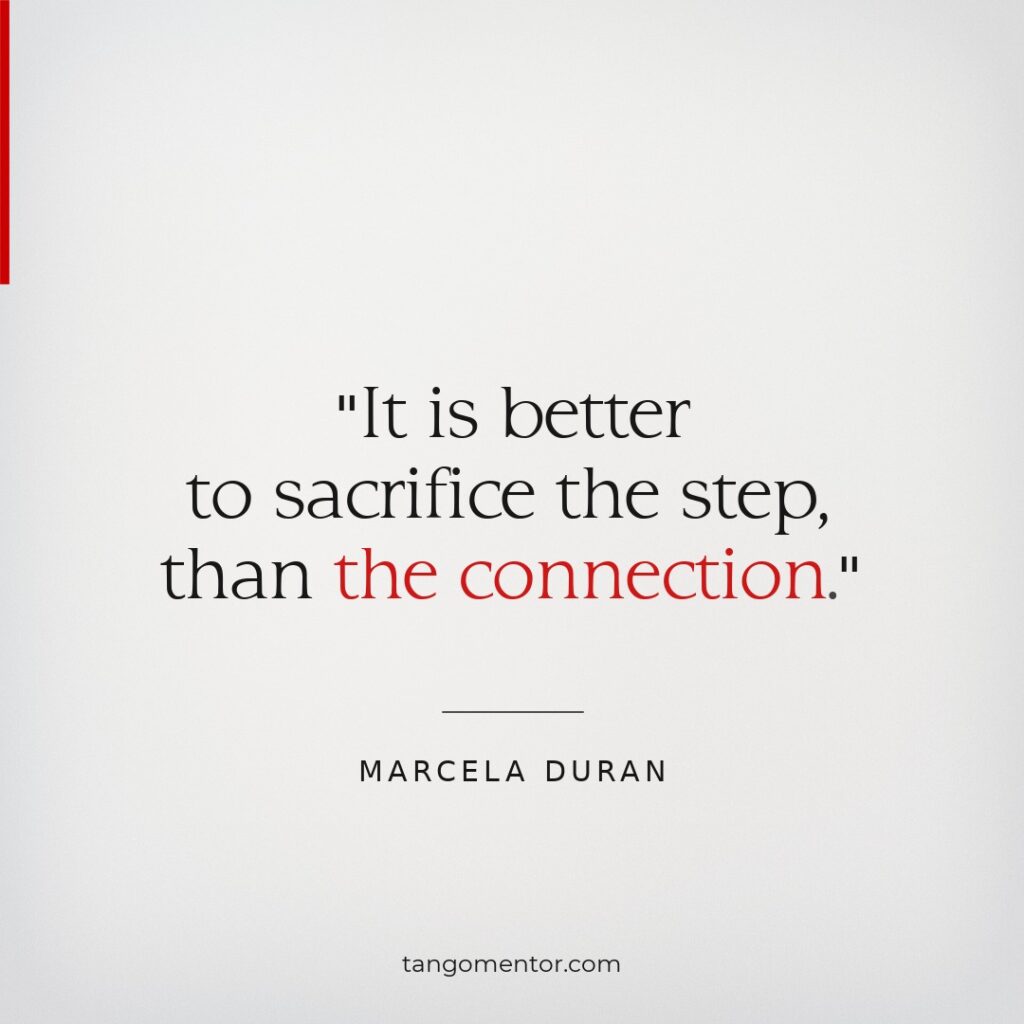
The goal: Your ability to create great connection depends on how much you focus on your partner. This should be the primary goal of everything you do. If you ever have to choose between a step and connection, choose connection – abandon the step if it threatens your connection.
How to achieve it: This is not simple. While dancing, many thoughts and feelings can pass through your mind: how the music feels, what people watching you think, what your teacher said, how the ronda flows. To maintain great connection, learn to push all of these into the background. For example, develop the ability to dance with musicality without needing to focus too much, so your attention can remain on your partner. That’s why experience matters.
I touched on many topics here – each could be a separate article or point of discussion. Remember, tango is personal; we all experience it differently. Maybe only one of these ideas will resonate with you, or maybe none. My hope is that it will at least make you think and come up with a solution that works for you, making your learning process more conscious and intentional.

Leave a Reply